The Shivering Reality of the Frozen Shop Floor
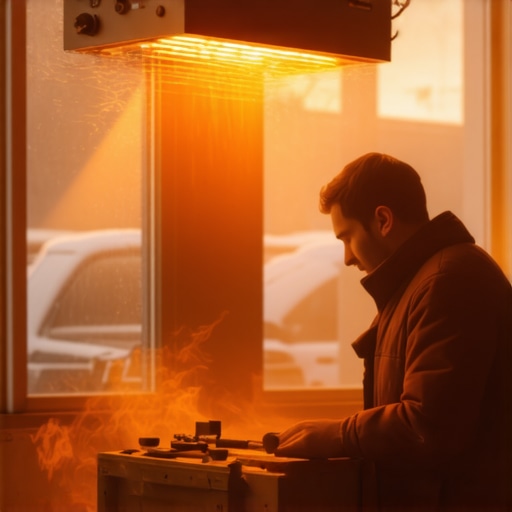
You’ve been there. It’s 5 AM in the middle of a January cold snap, the kind of weather that makes your socket set feel like it’s made of dry ice. You flip the switch on your forced-air furnace, the draft inducer motor begins its shrill, metallic whine, and you wait. And wait. Thirty minutes later, the air near the ceiling is a balmy 80 degrees, but your feet are still blocks of ice, and your tools are still too cold to handle without gloves. As an HVAC veteran who has spent three decades crawling through freezing crawlspaces and balancing airflow in drafty warehouses, I can tell you that most people approach shop heating entirely wrong. They think about air temperature when they should be thinking about molecular agitation. This is where the infrared shop heater enters the ring, and why it usually knocks out the traditional forced-air unit in the first round.
“The distribution of heat through radiation is the most fundamental and efficient form of energy transfer in large, uninsulated volumes.” – ASHRAE Systems and Equipment Handbook
My old mentor, a man who could sniff out a cracked heat exchanger from the driveway, used to scream at me, “You can’t heat what you can’t touch!” He wasn’t talking about the air; he was talking about the thermal mass of the building. In a shop environment, air is a terrible medium for holding heat. Every time you crack that bay door to move a project in or out, all that expensive “juice” you just paid to heat literally flies out the door. Forced-air systems rely on convection—heating the gas (air) and moving it around. Infrared, however, is a different beast. It’s the same physics that allows the sun to warm your face across 93 million miles of freezing vacuum. It’s radiant energy. It doesn’t care about the air; it vibrates the molecules in your concrete floor, your workbench, and your skin. When the floor is warm, the shop stays warm. It’s the difference between a hair dryer and a campfire.
The Thermodynamic Anatomy of Shop Comfort
Let’s do some Thermodynamic Zooming. In a forced-air setup, you’re often dealing with a furnace or a unit heater hanging from the rafters. The heat exchanger gets hot, the blower pushes air across it, and that hot air immediately rises to the highest point in the room. This is stratification at its worst. If your shop has 14-foot ceilings, you’re heating ten feet of dead space before you ever feel a lick of warmth at the bench. Furthermore, these units are mechanical nightmares as they age. I’ve seen more draft inducer motor repair calls in one winter than I care to count. These motors are the gatekeepers of combustion; if they don’t spin up to purge the heat exchanger, the whole system stays dead. Compare that to a high-intensity or tube-style infrared heater. There are fewer moving parts, no massive blowers stirring up sawdust and overspray, and the heat stays where the gravity is.
For those looking for a more integrated solution for their entire property, I often recommend dual fuel heat pump systems. These are the gold standard for modern efficiency. You get the surgical precision of an electric heat pump for shoulder seasons, and a gas furnace kicks in only when the temperature drops below the “balance point” where the heat pump loses its punch. But for the raw, uninsulated workspace? Infrared is king. If you’re currently struggling with a failing forced-air unit, you might be facing a heat pump replacement or a full furnace overhaul. Before you sign that five-figure check to some “Sales Tech” in a shiny polo shirt, you need to look at the physics of your space. Is it a leaky sieve? Then stop trying to heat the air.
The Regulatory Cliff and the 2025 Shift
We are currently staring down the barrel of a massive industry shift. The EPA is pushing low-GWP refrigerant retrofits and moving the market toward A2L refrigerants like R-454B. This means that heat pump replacement is becoming more complex and more expensive due to new sensor requirements and flammable gas mitigation. If you are planning a system overhaul, you should also be looking into rebate application assistance. There are thousands of dollars sitting in federal and state coffers for homeowners who switch to high-efficiency dual fuel systems or heat pumps, but the paperwork is a labyrinth. Don’t let a lazy contractor tell you the rebates don’t exist; they just don’t want to help you fill out the forms.
“Proper venting and combustion air are non-negotiable for any fuel-fired appliance to prevent the accumulation of lethal carbon monoxide.” – NFPA 54 / ANSI Z223.1
Whether you choose infrared or forced-air, the lifeblood of the system is the electrical and mechanical components. I’ve walked into shops where the owner complained the heater was dead, only to find a scorched wire that needed a simple wiring repair for heating systems. Other times, it’s a dead capacitor. Our capacitor replacement services are often the difference between a $200 fix and an $8,000 catastrophe. If you have an older building with a hydronic system, boiler maintenance services are non-negotiable. A boiler is a pressurized beast; neglect it, and you’re not just cold—you’re in a dangerous situation. I’ve seen boiler maintenance services skipped for years until the relief valve pops and floods a workshop. Don’t be that guy. Heating service hacks for comfort and savings in 2025 often start with simple, regular maintenance.
The Forensic Diagnosis: Infrared vs. Convection
How do you decide? Let’s look at the math. If your shop is well-insulated with finished walls and a sealed ceiling, a forced-air unit is fine. You can even integrate a voice control setup Alexa Google to warm the place up before you finish your coffee. It’s convenient, and you can find the right HVAC fixes easily. However, if your shop is a “tin shed,” a garage with zero insulation, or a place where you’re constantly opening big doors, forced air is a waste of money. You are literally trying to heat the outdoors. Infrared heaters don’t care about the draft. They keep the Mean Radiant Temperature (MRT) of the objects in the room high. Even if the air temperature drops 10 degrees because you opened the door, the concrete slab is still a giant thermal battery radiating heat back at you. This is why many techs consider infrared the ultimate “anti-scam” heater—it works where other things fail. Even for those in dry climates who might be used to swamp cooler maintenance in the summer, the winter requires a total pivot in thinking about how heat moves.
In the end, comfort isn’t just about a number on a thermostat. It’s about the rate of heat loss from your body. Forced air can make the room feel “stuffy” but leave your toes numb. Infrared makes you feel like you’re standing in the sun on a crisp fall day. If you’re unsure which way to go, check out our guide on urgent furnace repairs to see if your current system is even worth saving. Sometimes, the best repair is a total change in technology. Stay warm, keep your “Pookie” (mastic) thick on those duct joints, and remember: physics doesn’t lie, even when a salesman does.