The Airflow Manifesto: Why Horsepower is Nothing Without Physics
My old mentor used to scream at me until his face turned the color of a cherry-red heat exchanger: ‘You can’t cool what you can’t touch!’ He was a grizzled veteran who had seen the transition from R-12 to R-22, and he knew that airflow matters more than horsepower. This isn’t just a pithy saying; it’s the bedrock of thermodynamics. If your rooftop unit (RTU) has restricted return air or a layer of ‘pookie’ (mastic) that’s more cracks than sealant, the refrigerant—the ‘juice’—can’t do its job. We’re moving into an era where the chemistry of that juice is changing, and if your system’s airflow is trash, a low-GWP retrofit won’t save you; it will just expose the flaws in your tin knocker’s original design.
“The most expensive equipment in the world cannot overcome a bad duct system.” – Industry Axiom
The Regulatory Cliff: The Death of R-410A and the A2L Transition
We are standing at the edge of a massive shift in the HVAC industry. By 2025, the refrigerants we’ve relied on for decades, specifically R-410A, are being phased down in favor of low-GWP (Global Warming Potential) alternatives like R-454B and R-32. These are classified as A2L refrigerants—’mildly flammable.’ This isn’t a game-changer; it’s a structural mandate that affects heating service innovations transforming 2025 climate control. For owners of older rooftops, the cost of ‘topping off’ a leaking 410A system is going to skyrocket as supply vanishes. This is why we are pushing for proactive retrofits or full replacements before the price of a jug of gas hits the triple digits.
Thermodynamic Zooming: The Enthalpy of the Evaporator Coil
When we talk about ‘cooling,’ we aren’t adding cold; we are removing heat. In a northern climate, where we often see school boiler maintenance coinciding with RTU repairs, the physics of latent heat removal is critical. The evaporator coil must drop below the dew point of the ambient air to wring out the moisture. If you’re running an older rooftop with a fouled coil, the thermal transfer efficiency is shot. You’re not just wasting electricity; you’re slugging the compressor with liquid refrigerant because it didn’t have the surface area to boil off into a gas. This is where top HVAC repair strategies come into play—cleaning those fins to restore the thermodynamic bridge.
The Strategy: Retrofit vs. Replace in the Cold Zone
In regions where the winter involves ‘polar vortex’ scares, we often look at furnace repair and rooftop integrity simultaneously. If you have an older RTU, a retrofit to a lower GWP refrigerant can extend the life of the asset, but only if the mechanical organs are sound. We look at the contactor for pitting and the capacitor for bulging—the ‘heart’ and ‘brain’ of the electrical side. If the compressor is pulling high amps, no amount of new gas will fix a failing bearing. This is why preventative HVAC repair tips are vital; they identify the ‘sparky’ issues before they become mechanical catastrophes.
Beyond the Box: Integration of Gas and Insulation
A rooftop unit doesn’t live in a vacuum. If you’re doing an oil to gas conversion for your building’s main heating plant, it’s the perfect time to audit the RTUs. Often, the heat loss through the roof is so significant that the RTU is oversized to compensate. By investing in attic insulation for heating or roof deck insulation, we can actually downsize the equipment. Oversized units are the enemy of comfort; they ‘short cycle,’ meaning they turn on, blast the room with cold air, and turn off before they can dehumidify. You end up with a building that feels like a cold, damp basement.
“Design conditions shall be based on the latest ASHRAE climate data to ensure the equipment is neither undersized nor excessively oversized.” – ACCA Manual N/J Standard
Predictive Maintenance and Safety Protocols
In the modern era, we don’t wait for the screech of a failing blower belt. We use predictive maintenance alerts that monitor vibration and temperature deltas. Furthermore, with any fuel-burning equipment on the roof or in the basement, carbon monoxide detector installation is non-negotiable. Whether it’s a spa heater service or a commercial furnace repair, the combustion process must be vented perfectly. A cracked heat exchanger in an RTU can pump CO directly into the supply ducts, turning your HVAC system into a delivery method for poison. This is why we treat every inspection as a forensic diagnosis, not just a filter swap.
The Verdict: Why the Retrofit is the Smart Play Now
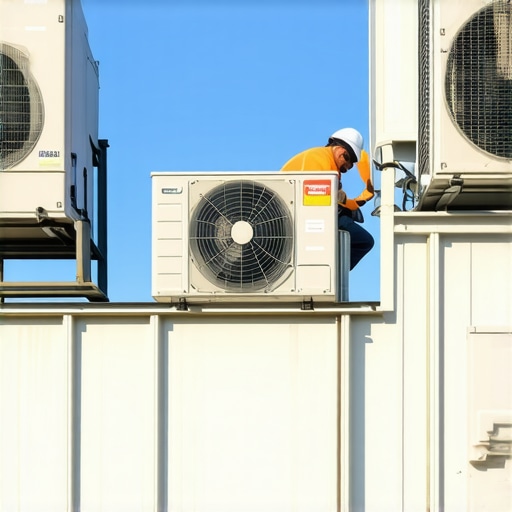
If your rooftop unit is between 10 and 15 years old, you are in the ‘Danger Zone.’ You can wait for the R-410A prices to bankrupt you, or you can look at the ultimate guide to AC installation and decide if a retrofit or a new A2L-ready system is the right move for 2025. Don’t let a ‘sales tech’ convince you that a $20 capacitor requires a $20,000 unit replacement, but don’t be a fool and ignore the chemistry of the future. The thermodynamic reality is that the industry is changing, and your airflow needs to be ready for it.”,”image”:{“imagePrompt”:”A professional HVAC technician in a grey uniform inspecting a large commercial rooftop unit on a flat roof during a clear day. He is using a digital manifold gauge set connected to the service valves. The background shows a suburban skyline with industrial vents and ductwork visible. The lighting is bright and natural, highlighting the technical detail of the copper lines and aluminum fins.”,”imageTitle”:”Professional HVAC Technician Inspecting Rooftop Unit”,”imageAlt”:”HVAC technician performing maintenance and refrigerant check on a commercial rooftop AC system”},”categoryId”:0,”postTime”:””}