I remember my first mentor, a grizzled old tin knocker named Sully, who used to stand in the middle of a grease-slicked kitchen, close his eyes, and scream, ‘You can’t move air if the lungs are full of gunk! This is why airflow matters more than horsepower!’ He wasn’t just being a cranky old man; he was teaching me the fundamental physics of static pressure and rotational mass. When you hear that low-frequency thrumming or feel the vibration shaking the prep tables in your restaurant, you aren’t just hearing a nuisance; you are hearing the sound of a mechanical system fighting against the laws of thermodynamics. In my 30 years on the roof, I have seen ‘Sales Techs’ try to sell a whole new exhaust package for $12,000 when the issue was actually a simple imbalance in the blower wheel or a failing motor mount.
“Proper ventilation is essential for maintaining acceptable indoor air quality in commercial kitchens, ensuring the removal of heat, grease, and smoke.” – ASHRAE Standard 154
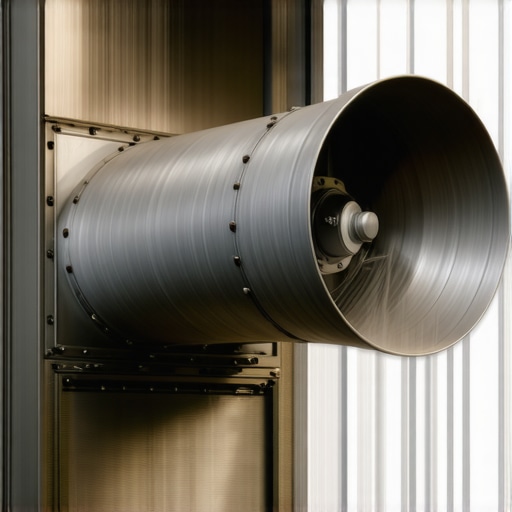
In the cold North, where we deal with polar vortexes and high-efficiency furnace installation, a vibrating exhaust fan is a catastrophe waiting to happen. If that fan fails in January, your kitchen turns into a carbon monoxide trap in minutes because your flue pipe installation and makeup air units can’t compensate for the lack of pull. The vibration is usually a symptom of ‘The Centrifugal Slingshot.’ Grease is heavy. When it accumulates unevenly on the blades of your squirrel cage fan, it creates an imbalanced load. At 1,750 RPM, a few ounces of grease becomes a sledgehammer hitting the bearings with every rotation. This is where duct cleaning services become a mechanical necessity rather than just a fire code checkbox.
The Anatomy of the Shake: Motor vs. Airflow
Let’s do some thermodynamic zooming. Your exhaust fan works by creating a pressure differential. It pulls sensible heat (the heat you feel) and latent heat (the moisture from that boiling pot of pasta) out of the building. To do this, the motor has to overcome the resistance of the ductwork. If your ducts are choked with grease, the static pressure skyrockets. The motor works harder, draws more amps, and gets hot. I have smelled the acidic, sour odor of a winding burning out more times than I can count. Often, the vibration starts because the capacitor is weakening. Our capacitor replacement services are often the first line of defense; if the capacitor isn’t providing the right phase shift, the motor will ‘growl’ and vibrate as it struggles to maintain torque.
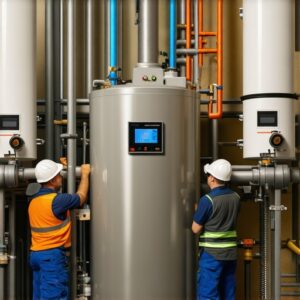
Then there is the issue of the belt. A ‘tin knocker’ knows that a belt too tight will eat the bearings, while a belt too loose will slap the housing. In hotel boiler services or large-scale commercial setups, we see this vibration travel through the entire structural steel of the building. It’s not just a kitchen problem; it’s a structural one. If you’re in a region like Chicago or the Northeast, the cold air hitting that hot grease causes it to solidify faster, compounding the imbalance. This is why emergency heating repair and exhaust maintenance are two sides of the same coin during a brutal winter.
“The most expensive equipment in the world cannot overcome a bad duct system.” – Industry Axiom
The R-454B Transition and Your Future Kitchen
As we move into 2025, the industry is shifting. We are moving away from R-410A toward ‘mildly flammable’ A2L refrigerants. Our R-454B refrigerant transition services are becoming critical for restaurant owners because your walk-in coolers and rooftop units are all going to change. These new systems require precise airflow management. If your exhaust fan is vibrating and causing negative building pressure, it can actually interfere with the sensors in your new high-efficiency equipment. You can’t just slap ‘Pookie’ (mastic) on a leak anymore and call it a day; these systems require surgical precision. Whether it is a new construction heating design or retrofitting hyper-heat heat pumps for your dining area, the balance of air must be perfect.
Repair vs. Replace: The Financial Reality
Should you spend $800 on a new motor and balance the wheel, or $5,000 on a new fan assembly? If the housing is rusted or the curb is leaking, pull the plug. But if it’s just a grease-heavy wheel, a thorough cleaning and a new set of bearings will save you thousands. Don’t let a ‘Sales Tech’ tell you that a little vibration means the whole unit is ‘shot.’ I have seen fans from the 1970s run smoother than new units because they were built with real steel and maintained by someone who actually knew how to use a grease gun. For those looking at heat pump installation or boiler upgrades, remember that your exhaust system is the ‘out’ for your building’s lungs. If it’s shaking, your whole building is stressed.