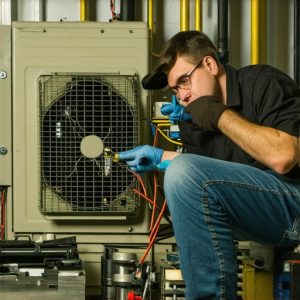
I remember Old Man Miller, a guy who had been turning wrenches since the R-12 days, used to grab my shoulder until it bruised and yell, ‘Physics doesn’t care about your feelings, kid! You can’t move heat if you can’t move the medium!’ He was right. When your spa heater starts sounding like a sledgehammer hitting an anvil, it is not a ghost in the machine; it is a fundamental physics failure. Most ‘Sales Techs’ will roll up in a clean van, look at your unit for three minutes, and tell you the heat exchanger is shot, quoting you for a full system replacement before they even check the bypass valve. But here is the truth: that banging is usually the ‘Kettle Effect.’ When scale builds up from hard water—the same minerals that plague your boiler maintenance services—it creates a thermal barrier. Water gets trapped under a layer of calcium, hits its boiling point, and flashes into steam. That steam bubble collapses instantly when it hits cooler water, creating a miniature sonic boom. That is the ‘bang’ you are hearing. It is the sound of your copper heat exchanger screaming for help because you didn’t identify when furnace repair is urgent or maintain your hydronic loops.
The Forensic Diagnosis: Anatomy of the Bang
In the North, where we deal with massive temperature swings, we see this often. Your spa heater is essentially a high-output boiler. When the flow rate drops, the ‘juice’ (in this case, the thermal energy from the gas burner) has nowhere to go. If your pump is failing or your filter is clogged with hair and oils, the water spends too much time inside the heat exchanger. It moves from sensible heat—where the temperature rises—to latent heat, where it undergoes a phase change.
“Water is the most efficient medium for heat transfer, but the most unforgiving of poor velocity.” – ASHRAE Fundamentals Handbook
This lack of velocity is the enemy. It is the same reason why crawl space heating solutions fail when the ‘Tin Knocker’ didn’t size the return air correctly. If you can’t move the air, you can’t move the heat. If you can’t move the water, the water turns to steam and tries to blow your pipes apart.
The Scale Factor and Gas Line Integrity
Let’s talk about the ‘Liming’ of the system. In cold climates, we often see gas line installation for furnaces and spa heaters that were sized by someone who didn’t know a manometer from a meat thermometer. If the gas pressure is too high, the flame is too hot. If the gas pressure is too low, the burner ‘huffs.’ But the banging? That is almost always the heat exchanger tubes becoming a tea kettle. This is why hot water heater repair and spa maintenance go hand-in-hand. You need to descale that unit with a mild acid flush. If you don’t, that calcium will eventually cause the copper to fatigue and crack. Then you aren’t just looking at a repair; you are looking at a full AC installation style overhaul of your outdoor equipment.
Relay Services and the Electrical ‘Clunk’
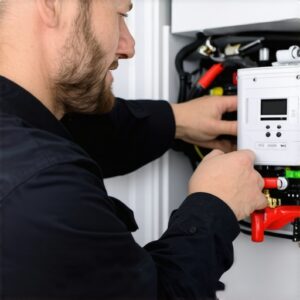
Sometimes the bang isn’t hydronic—it is electrical. I have seen relay services where a chatter in the contactor sounds like a machine gun. If your thermostat wiring upgrades were done by a ‘Sparky’ who didn’t understand low-voltage DC signals, your heater might be rapidly cycling on and off. This causes the gas valve to slam shut and open, creating a ‘gas hammer’ effect. This is why AI-driven HVAC optimization is becoming a thing; sensors can now detect these micro-vibrations before they become catastrophic failures. If you are hearing a click-clack before the boom, your issue might be in the control board or the relay logic, not the water flow.
“Proper gas piping diameter and regulated pressure are non-negotiable for equipment longevity.” – NFPA 54 National Fuel Gas Code
The Hyper-Heat Alternative
If you are tired of the maintenance nightmare of gas-fired spa heaters, many homeowners are moving toward hyper-heat heat pumps. These units don’t rely on a 200,000 BTU blast of flame. They use the same tech we use for ductless mini-split installation, extracting heat from the ambient air even in freezing temperatures and transferring it to the water. It is slower, but it is infinitely more efficient and doesn’t suffer from the ‘Kettle Effect’ in the same way. Plus, you don’t have to worry about ‘Pookie’ (mastic) or venting issues in your crawl space heating solutions if you are moving away from combustion.
The Math: Repair vs. Replace
Should you pull the plug? A heat exchanger for a high-end spa heater can run you $1,200 plus labor. If the rest of the unit is ten years old and the cabinet is rusting out, you are throwing good money after bad. However, if the banging is just a bad flow switch or a $200 pump, you fix it. This is why heating service innovations are so important—they give us the tools to actually measure flow and pressure instead of just guessing. If you are hearing those noises, contact us before the steam pressure turns your spa into a backyard geyser. Proper strategies to extend your systems life always start with listening to what the equipment is trying to tell you through the noise.