The Sound of a Dying Mechanical Heart
Listen closely. That high-pitched whine echoing through your floor vents isn’t a ghost; it’s the sound of a PSC blower motor screaming for mercy. As an HVAC veteran who has spent three decades dragging my tool bag through spider-infested crawl spaces and freezing attics, I can tell you that the blower motor is the lungs of your home. When it fails, the whole system suffocates. But here is the kicker that most ‘Sales Techs’ won’t tell you: if your motor is toast, your capacitor is likely the murder weapon, and replacing one without the other is like putting a new heart in a patient while leaving the clogged arteries untouched.
The Physics of the Spin: Why Airflow is King
My old mentor, a man who could smell a gas leak from a block away, used to scream at me, ‘You can’t cool what you can’t touch!’ This wasn’t just old-man rambling; it was a fundamental lesson in thermodynamics. If your blower isn’t moving the requisite 400 CFM (cubic feet per minute) per ton of cooling across that evaporator coil, the physics of heat transfer simply break down. The refrigerant in the suction line stays too cold because it can’t absorb enough sensible heat from your home’s air. This leads to the evaporator coil dropping below the dew point so aggressively that it doesn’t just dehumidify; it freezes solid into a block of ice. Once that happens, you’re not just looking at a motor repair; you’re looking at a liquid slugging disaster that can kill your compressor.
“The most expensive equipment in the world cannot overcome a bad duct system or insufficient airflow.” – Industry Axiom
The Forensic Diagnosis: The Capacitor is the Culprit
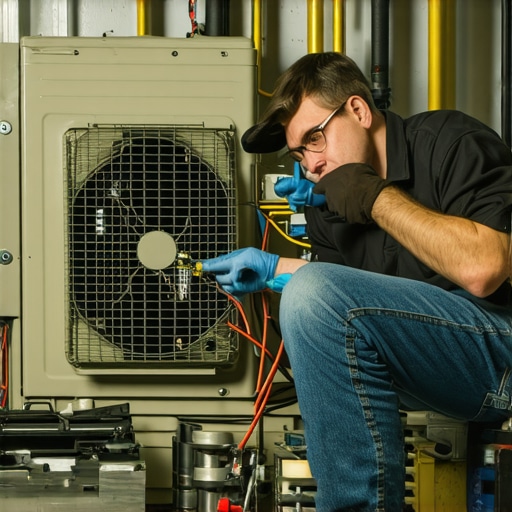
When I roll up to a ‘no-heat’ call in a Northern winter—where cracked heat exchangers are the primary threat—the first thing I do is check the microfarads on the run capacitor. You see, an induction motor needs a phase shift to create the torque required to spin. The capacitor provides that electrical ‘push.’ Over time, the electrolyte inside these silver cans bakes under the heat of the furnace cabinet. When a capacitor’s value drops by even 10%, the motor starts to run hot. It’s no longer in sync with the magnetic field. This generates eddy currents and internal heat that cooks the Class B insulation on the copper windings. By the time the motor finally seizes or the thermal overload clicks open for the last time, that capacitor is long gone. Installing a shiny new motor with a weakened, five-year-old capacitor is a recipe for a warranty call-back within six months. I don’t do call-backs. I do it right the first time.
Climate Context: The Polar Vortex Struggle
In our neck of the woods, where the polar vortex isn’t just a news headline but a yearly reality, your blower motor works double duty. If you’re running dual fuel heat pump systems, that blower is active nearly year-round. During the defrost cycle of a heat pump, the blower has to stay perfectly calibrated to manage the sudden shift in coil temperature. If the motor is sluggish, you risk ‘flame rollout’ in your gas furnace backup or ice buildup that can warp the tin knocker’s beautiful ductwork. This is why we emphasize top HVAC repair strategies that focus on the electrical health of the entire drive assembly.
The Economic Reality: Repair vs. Replace
I get it. A blower motor replacement isn’t cheap. You’re looking at $500 to $900 depending on if it’s a standard PSC or one of those fancy ECM (Electronically Commutated Motors). The capacitor is a $20 to $60 part. When a tech tells you that you need both, don’t think he’s ‘padding the bill.’ He’s saving you a second Sparky or HVAC visit. If you ignore the motor’s health, the lack of airflow causes the heat exchanger to overheat and crack. Now you’re not talking about a $600 repair; you’re talking about an $8,000 furnace replacement because you’ve got carbon monoxide leaking into your crawl space heating solutions. It is always cheaper to maintain the mechanical anatomy than to replace the whole organism.
Advanced Air Management: Zoning and Purification
In 2025, we aren’t just moving air; we’re conditioning it. When we perform manual J calculations, we aren’t just looking at the size of the box; we’re looking at the static pressure. Adding air purification integration or high-MERV filters increases the resistance the blower motor must overcome. If your motor is already struggling with a weak capacitor, adding a heavy-duty filter will be the final nail in its coffin. If you’re interested in zoning system installation, where dampers open and close to direct air to specific rooms, your blower motor must be in peak condition to handle the fluctuating static pressure without burning out. This is where efficient HVAC repairs become the blueprint for long-term comfort.
“Failure to maintain proper airflow across the heat exchanger can lead to premature structural failure and unsafe operating conditions.” – ASHRAE Standard 15.2
The 2025 Transition: R-454B and Beyond
We are entering the era of ‘mildly flammable’ refrigerants. With the transition to A2L refrigerants like R-454B, the role of the blower motor becomes even more critical. New systems often include sensors that trigger the blower if a leak is detected to dilute the ‘gas’ (refrigerant) below its flammability limit. A dead blower in 2025 isn’t just a comfort issue; it could be a safety compliance issue. While you’re looking at ultimate guide to AC installation, remember that the reliability of that new unit hinges on the electrical components we’re discussing today.
Conclusion: Don’t Step Over a Dollar to Save a Dime
If your technician pulls a capacitor out and it looks like a bloated soda can, or if his meter shows it’s out of spec, just change it. And if that motor has been hum-locking for three days while you waited for a pro to show up, do yourself a favor and replace the motor too. It’s been through a thermal war. We offer rebate application assistance for high-efficiency motor upgrades that can actually pay for themselves in electrical savings over three years. Don’t be the homeowner who tries to save fifty bucks only to lose five thousand. Trust the physics, trust the airflow, and for heaven’s sake, keep your pookie-sealed ducts clear. If you’re smelling that acidic, sour scent of a motor burnout, it’s already too late. Contact us today to get a real diagnostic before the next cold front hits.