The Sunset of R-410A and the 2025 Cold Reality
The industry is currently standing on a regulatory cliff, and if you listen closely, you can hear the sound of homeowners’ checkbooks screaming. By 2025, R-410A—the ‘gas’ we have used for two decades—is being phased out for new equipment in favor of A2L refrigerants like R-454B. This isn’t just a minor tweak; it is a total overhaul of the thermodynamic cycle as we know it. I recently followed a ‘Sales Tech’ who told a homeowner in a drafty Victorian that her entire system was ‘illegal’ because it used 410A. He quoted her $19,000 for a full swap, including an oil to gas conversion she didn’t even ask for. I found a hairline fracture in a $30 capacitor. The system wasn’t illegal; it was just being used as a prop in a high-pressure sales pitch. Understanding the physics of the transition is the only way to avoid being taken for a ride. R-454B is a blend of R-32 and R-1234yf, and it carries a ‘mildly flammable’ rating. This means the new units come with leak sensors and mitigation boards that the old ‘tin’ sitting in your yard simply wasn’t built to handle.
“The most expensive equipment in the world cannot overcome a bad duct system.” – Industry Axiom
Thermodynamic Zooming: Why You Can’t Just ‘Swap the Juice’
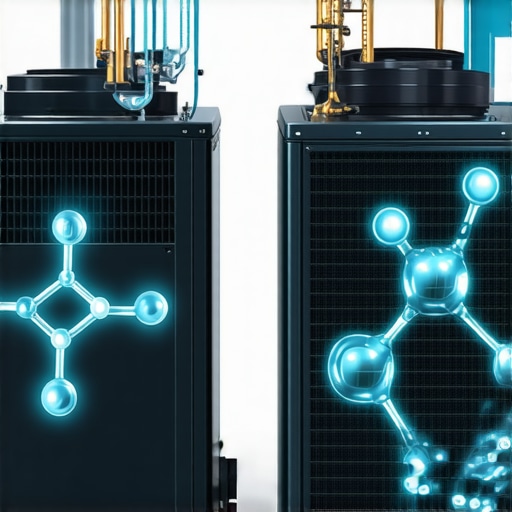
When we talk about R-454B compatibility with older cooling units, we are talking about chemistry and pressure. You cannot simply drop R-454B into an R-410A system. The expansion valves (TXV) are calibrated for specific mass flow rates and pressure-temperature relationships. If you try to mix them, you’ll end up with a ‘slugged’ compressor—which sounds like a handful of gravel in a blender before the whole thing seizes up. In colder climates where we deal with radiator replacement and radiant floor heating installation, the transition is even more complex. We are seeing a massive push toward dual fuel heat pump systems that pair an electric A2L coil with a gas furnace. The challenge is the ‘glide’—the temperature range over which the refrigerant evaporates. R-454B has a different glide than 410A, meaning the indoor evaporator coil needs more surface area to strip latent heat from the air. Without proper sizing, you aren’t cooling; you’re just moving humid air around a cold box. If your modulating furnace repair technician doesn’t understand the Delta T requirements for these new coils, your house will never feel right. This is why preventative HVAC repair tips for year-round efficiency are becoming mandatory rather than optional.
The Airflow Manifesto: Beyond the Refrigerant
Airflow is king. You can have the most advanced AI-driven HVAC optimization software in the world, but if your tin knocker didn’t size the return air drops correctly, you’re burning money. In the North, where we deal with tight envelopes and heat recovery ventilators (HRVs), the static pressure in the ductwork is often the silent killer of compressors. When a compressor fails, it doesn’t just ‘stop.’ It undergoes a burnout, creating an acidic, sour-smelling sludge that ruins everything it touches. I’ve seen propane conversion services fail because the technician didn’t account for the increased heat rise, which then cooked the cooling coil’s drain pan. Even restaurant kitchen exhaust repair requires a deep understanding of make-up air; if you don’t replace the air you suck out, your AC unit is fighting a vacuum. We often see this in residential settings where oversized units ‘short cycle,’ turning off before they can drop the dew point. This is why ultimate guide to ac installation expert tips for 2025 success emphasizes proper Manual J calculations over ‘rule of thumb’ guessing.
“Designers shall use the procedures outlined in ACCA Manual J to determine the heating and cooling loads of the building.” – ASHRAE Standard 183
The Repair vs. Replace Math: Navigating the Transition
Is your old R-410A unit worth a $1,500 repair? If the suction line is ‘beer can cold’ and the compressor is healthy, maybe. But if you’re looking at a leaking evaporator coil, you’re at a crossroads. The price of R-410A ‘gas’ is skyrocketing as production quotas drop. Investing in top hvac repair strategies to extend your systems life might buy you a few years, but the 2025 mandate is the finish line. We are also seeing a rise in pool heater repair calls where the heat pump technology is shifting similarly. For homeowners, the goal is to avoid the ‘panic buy.’ Don’t wait for a 95-degree day for your system to die. If you’re currently using an old oil boiler, now is the time to look at oil to gas conversion paired with a modern A2L heat pump. You can learn how to identify when furnace repair is urgent and why before the emergency rates kick in. Remember, a good technician uses ‘pookie’ (mastic) on the joints and checks the static pressure with a manometer; a ‘sales tech’ just looks at the age of the unit and reaches for a contract.
The A2L Safety Protocol
Because R-454B is A2L (mildly flammable), the ‘sparky’ (electrician) and the HVAC tech have to be more careful than ever. New units will have sensors that shut down the system and start the indoor blower if a leak is detected, diluting the refrigerant to safe levels. If you are getting efficient hvac repairs the blueprint for cooler summers and warmer winters, ensure your tech is EPA Section 608 certified for these new blends. Whether it is a radiator replacement project or a complex dual fuel heat pump system, the physics of heat transfer remain the same. Respect the latent heat, seal your ducts with pookie, and never trust a tech who doesn’t carry a vacuum pump and a micron gauge.
{“@context”: “https://schema.org”, “@type”: “HowTo”, “name”: “Evaluating R-454B Compatibility”, “step”: [{“@type”: “HowToStep”, “text”: “Identify the refrigerant type on your current outdoor unit nameplate.”}, {“@type”: “HowToStep”, “text”: “Check expansion valve compatibility for A2L refrigerants.”}, {“@type”: “HowToStep”, “text”: “Verify if the indoor coil can handle the pressure and glide of R-454B.”}, {“@type”: “HowToStep”, “text”: “Determine if leak mitigation sensors are required by local building codes.”}]}