The Sound of Stalled Potential
That low-frequency, 60Hz thrumming coming from your outdoor condenser isn’t just an annoyance; it’s the sound of a motor crying for help. When you hear that hum but the fan isn’t spinning and the compressor isn’t kicking over, you aren’t looking at a dead machine—you’re looking at a machine that’s lost its ‘kick.’ In my thirty years of crawling through crawlspaces and sweating on black-top roofs, I’ve seen thousands of these calls. Homeowners always think the ‘juice’ is gone or the whole unit is fried. Usually, it’s much simpler and, if you catch it fast, much cheaper. But if you let that hum continue, you’re literally cooking the windings of your compressor from the inside out.
“The most expensive equipment in the world cannot overcome a bad duct system.” – Industry Axiom
My old mentor, a grizzled tech we called ‘Iron Lung’ Miller, used to scream at me every time I reached for my gauges too early. ‘You can’t cool what you can’t touch!’ he’d yell. He was obsessed with airflow. He taught me that the electrical components are just the messengers, but the physics of airflow and thermodynamics are the law. If your outdoor unit is humming, the message is being sent, but the execution is failing. This often happens because the system is fighting against itself. Whether it’s high head pressure from a clogged coil or a capacitor that’s given up the ghost, the unit is stuck in a state of ‘Locked Rotor Amps’ (LRA). In this state, the compressor is drawing five to six times its normal operating current, generating massive amounts of internal heat that the refrigerant can’t carry away because the pump isn’t pumping.
The Forensic Diagnosis: Anatomy of the Hum
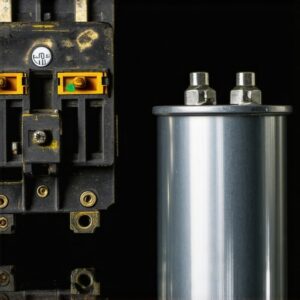
To understand why the unit won’t start, we have to look at the ‘pacemaker’ of the HVAC world: the run capacitor. Most residential units use a permanent split capacitor (PSC) motor. These motors need a phase shift to create the torque required to start spinning. The capacitor creates this shift. When the ‘Sparky’ (electrician) ran the 240V line to your disconnect, he provided the raw power, but the capacitor provides the timing. If that silver cylinder has leaked its oil or bulged at the top, the phase shift disappears. The motor receives power, but it has no ‘direction’ to spin. It just sits there and vibrates—that’s your hum.
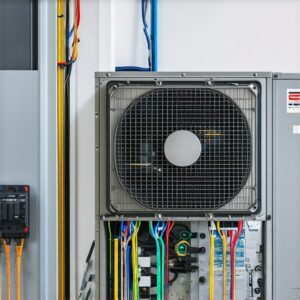
But don’t just swap a cap and walk away. A real tech asks why the capacitor failed. In our cold Northern climate, we see different stressors than the boys down South. We deal with extreme temperature swings that cause expansion and contraction in electrical terminals. During a winter where you might be relying on a heat pump, or perhaps you’re more focused on your chimney liner installation and furnace safety, the outdoor unit sits dormant, collecting moisture. This moisture leads to corrosion on the contactor—the gatekeeper of the high voltage. If the contactor points are ‘pitted’ or charred, they might only be sending a partial voltage to the compressor, causing it to hum and stall.
The North’s Hidden Killers: Carbon Monoxide and Latent Heat
Since we’re up here in the land of ice and snow, the outdoor hum is only half the story. When the AC fails in July, it’s a comfort issue. When the furnace fails in January, it’s a survival issue. This is why carbon monoxide detector installation is non-negotiable. If you’re running a gas furnace or a pellet stove, you need to ensure your venting is pristine. A failing pellet stove repair or a blocked chimney can push deadly gases back into the home. We often see homeowners trying to ‘seal up’ their homes too tight for efficiency, forgetting that fire needs to breathe. If you don’t have proper gas line installation for furnaces that accounts for combustion air, you’re asking for trouble.
In the winter, we also battle the ‘dry rot’ of the lungs. This is where steam humidifiers come in. Unlike the cheap ‘water pad’ bypass humidifiers that just grow mold, a steam humidifier actually boils water and injects pure gaseous H2O into the ductwork. This protects your hardwood floors, your skin, and your family’s health. But it adds complexity. You need programmable thermostat programming that can handle ‘humidity call’ logic, ensuring the blower runs when the steamer is active, or you’ll end up with a rusted-out heat exchanger and a puddle in your plenum. If your system isn’t balanced, you’re just wasting money on heating service hacks that don’t work.
The 2025 Regulatory Cliff: R-454B and Low-GWP Retrofits
We are currently standing at the edge of the biggest shift in HVAC history since the phase-out of R-22. The industry is moving toward ‘Mildly Flammable’ (A2L) refrigerants like R-454B and R-32. This is the era of low-GWP refrigerant retrofits. If your old R-410A unit hums and it turns out the compressor is truly grounded, you’re in a tough spot. Replacing that unit now means navigating a market where prices are skyrocketing due to these new safety standards. The new units require leak detector integration built right into the cabinet to sniff out A2L leaks. This is why ultimate guide to ac installation expertise is more valuable now than ever. You can’t just slap a new condenser on an old coil anymore; the chemistries don’t mix, and the pressures are different.
“A deficiency in airflow across the evaporator coil will result in liquid refrigerant returning to the compressor, leading to premature mechanical failure.” – ACCA Manual S
If you’re a business owner, commercial furnace repair follows the same logic but on a massive scale. A humming rooftop unit (RTU) on a restaurant might be a seized blower motor. If that blower doesn’t move air over the heat exchanger, the metal will crack in minutes, potentially dumping CO into the dining room. This is why system performance testing—measuring static pressure and temperature rise—is the only way to prove a system is actually working. You can’t just ‘feel the air’ and know it’s right. You need tools.
Repair vs. Replace: When to Pull the Plug
So, your unit is humming. You’ve checked the capacitor (it’s $50-$100) and the contactor (it’s $30-$60). If those are good and the unit still hums, we perform a ‘bench test’ on the compressor. We check for ‘ground’ (when the internal wires touch the metal shell) and ‘shorts.’ If the compressor is ‘slugged’ with liquid refrigerant because of a bad expansion valve or a ‘Tin Knocker’ (duct guy) who undersized the return air, the repair is going to be in the thousands. At that point, you have to look at the age of the unit. If it’s over 12 years old and uses R-410A, I’m telling you to save your money for a new system. Check out choosing the right hvac fixes to see how we weigh these costs.
Don’t fall for the ‘Sales Tech’ who walks in, sees a humming unit, and immediately starts writing a quote for $18,000 without even taking the side panel off. A real tech will use a ‘hard start kit’ (a relay and a start capacitor) to try and ‘kick’ a stuck compressor back to life. Sometimes, that ‘kick’ can buy you another two or three years of life. That’s the difference between a technician who knows the physics of torque and a salesman who only knows the physics of his commission check.
Conclusion: Physics Over Magic
In the end, HVAC is just moving heat from where it isn’t wanted to where it doesn’t matter. Whether you’re dealing with leak detector integration in a modern high-efficiency heat pump or a basic gas line installation for furnaces, the principles remain the same. Respect the airflow, maintain the electrical ‘pacemaker,’ and never ignore a hum. A hum is a warning. If you hear it, turn the thermostat to ‘Off’ immediately and call someone who knows the difference between a start winding and a run winding. Your compressor—and your wallet—will thank you. For more on keeping your system running long-term, read about top hvac repair strategies.