The Smell of Neglect: Why Your Reservoir is a Science Experiment
I’ve spent thirty years dragging my tool bag across sun-bleached roofs where the ambient temperature hits 115°F before lunch. I’ve seen it all, but nothing hits quite like the ‘dirty sock’ stench of a swamp cooler that hasn’t been touched since the previous monsoon season. If you’re smelling that sour, swampy funk, you aren’t just cooling your house; you’re aerosolizing a petri dish. My old mentor, a grizzled tin knocker who could find a refrigerant leak by ear, used to scream, ‘You can’t cool what you can’t touch!’ He wasn’t just talking about the air hitting the water; he was talking about the physics of the exchange. If your reservoir is coated in an inch of calcium scale and slime, the water isn’t moving, the heat isn’t leaving, and you’re just burning electricity to make your living room feel like a humid locker room.
“Evaporative cooling equipment shall be maintained to prevent the growth of legionella and other micro-organisms.” – ASHRAE Standard 188
Before we get into the scrub brush and the biocides, understand the Thermodynamic Zooming here. A swamp cooler (evaporative cooler for the folks who like fancy terms) works on the principle of sensible heat being converted to latent heat. When dry air passes through those saturated pads, the water evaporates, drawing energy from the air and dropping the temperature. But here is the catch: minerals don’t evaporate. Every gallon of water your unit gulps down leaves behind a microscopic pile of salt and minerals. Over a season, that reservoir becomes a concentrated brine that eats through metal and provides a high-rise apartment for bacteria. If you don’t disinfect it properly, you’re looking at a system failure that no HVAC repair strategy can save.
Step 1: The Great Purge and the Pookie Check
First, kill the power. Don’t be the guy who gets a 120-volt kiss because he was too lazy to flip the breaker. Drain the reservoir completely. If you’ve got a bleed-off line, check it for clogs. While the pan is empty, I want you to look at the transition duct. Is the Pookie (mastic) cracked? If air is leaking out before it hits your vents, you’re wasting money. This is the same logic we use during AC installation—static pressure is the boss. If the reservoir has standing ‘juice’ or slime, use a wet-vac to get every last drop out. You’re looking for a clean slate.
Step 2: Scrubbing the Scale (The Sweat Equity Phase)
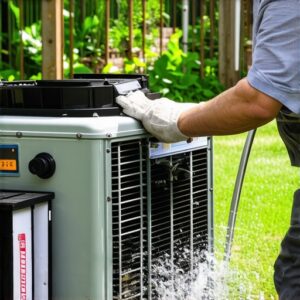
You can’t just pour bleach in and walk away. You need to break the biofilm. Use a stiff nylon brush and a mixture of white vinegar and water to break down the calcium. Avoid harsh acids that can eat through the galvanized coating of the pan. If you’ve got a stainless steel reservoir, you’re lucky, but most of you are dealing with thin metal that’s one rust-spot away from a catastrophic leak. While you’re down there, check your pump screen. A clogged screen is how pumps burn out, and I’ve seen plenty of ‘Sales Techs’ try to quote a whole new unit when a $2 worth of cleaning would have solved it. This isn’t like furnace repair where you’re dealing with flame sensors; this is pure fluid dynamics.
Step 3: The Disinfection Protocol
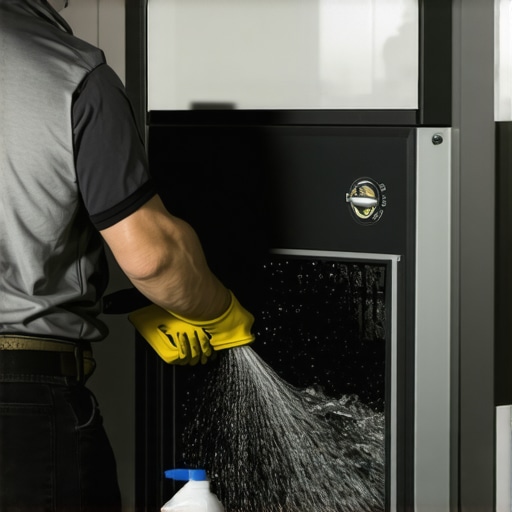
Once the scale is gone, it’s time to kill the invisible stuff. Use an EPA-approved evaporative cooler cleaner or a very mild bleach solution (one tablespoon per gallon of water). Circulate this through the pump without the fan running for at least 15 minutes. This ensures the biocide hits the distribution spider tubes and the top of the pads. This is critical for demand-controlled ventilation—you want the air coming in to be sterile. After the soak, drain it again and rinse with fresh water. If you leave the bleach in there, it’ll eat your pads and leave you with a chemical smell that’ll peel your eyelids back.
“The most expensive equipment in the world cannot overcome a bad duct system or poor maintenance.” – Industry Axiom
Transitioning to the Heating Season: Don’t Get Caught Cold
In the Southwest, we flip from cooling to heating faster than a contactor snaps shut. When you’re done disinfecting that swamp cooler for the winter, don’t forget the other half of your system. This is the time for furnace filter replacement and furnace flame sensor cleaning. I can’t tell you how many service calls I get in October for a ‘broken furnace’ that just has a dirty sensor. If you’re running a fireplace insert, ensure you’ve scheduled your fireplace insert services and a combustion analysis to make sure you aren’t pumping CO into your bedroom. If your house feels like a desert once the heater kicks on, consider a humidifier installation to keep the wood floors from shrinking.
The Reality of Maintenance vs. Emergency
Look, I get it. Nobody wants to spend their Saturday on a ladder. But the difference between a $20 bottle of disinfectant and a $15,000 system replacement is just 30 minutes of effort. Whether it’s commercial furnace repair or a portable heater safety check, the physics don’t change. Heat transfer is a ruthless business. If you ignore the reservoir, the ‘Monsoon Effect’ will turn your cooler into a rust bucket by August. If you’re unsure about your system’s health, or if you suspect a slow leak, getting a professional refrigerant leak detection or a full system audit is the only way to sleep easy. Don’t wait for the bearings to start screeching; by then, the damage is done. Keep it clean, keep the airflow moving, and tell those Sales Techs to stay off your roof. [HowTo Schema: {“@context”:”https://schema.org”,”@type”:”HowTo”,”name”:”Disinfecting a Swamp Cooler Reservoir”,”step”:[{“@type”:”HowToStep”,”text”:”Turn off all power and water supply to the unit.”},{“@type”:”HowToStep”,”text”:”Drain the reservoir and remove any debris or standing silt using a wet-dry vacuum.”},{“@type”:”HowToStep”,”text”:”Scrub the reservoir walls with a vinegar-based solution to remove mineral scale.”},{“@type”:”HowToStep”,”text”:”Apply an EPA-approved biocide or mild bleach solution and circulate via the pump for 15 minutes.”},{“@type”:”HowToStep”,”text”:”Flush the system with fresh water and refill the reservoir.”}]}]