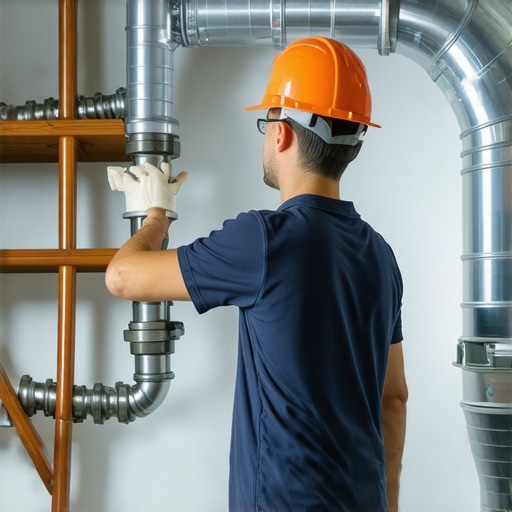
My old mentor, a grizzled tin knocker who’d forgotten more about thermodynamics than most engineers ever learn, used to scream at me over the roar of a 100,000 BTU burner: “You can’t cool what you can’t touch, and you sure as hell can’t heat if you can’t breathe!” He’d smack the side of a galvanized vent pipe with a wrench to make his point. To him, the flue wasn’t just a pipe; it was the exhaust manifold of the home’s mechanical lungs. If the slope was off by a fraction of an inch, or the clearance was too tight, he didn’t just see a code violation—he saw a slow-motion disaster waiting to happen. This is the reality of the North; when the polar vortex hits and your system is running 24/7, your furnace’s ability to vent combustion gasses is the only thing standing between your family and a silent, odorless tragedy.
The Forensic Anatomy of Exhaust: Why Codes Aren’t Suggestions
When I walk into a basement for furnace repair services, I don’t look at the thermostat first. I look at the flue. In our cold northern climate, the delta-T (the difference between the roaring flame inside and the sub-zero air outside) is massive. This creates extreme thermal stress. Flue pipe installation codes, primarily governed by NFPA 54 (the National Fuel Gas Code), exist because combustion is a chemical reaction that produces carbon monoxide, water vapor, and acidic condensates. If that exhaust doesn’t leave the building efficiently, it stays. And if it stays, you’re in trouble.
“The most expensive equipment in the world cannot overcome a bad duct system—or an improperly vented combustion chamber.” – Industry Axiom
We see two main types of venting in modern homes: Category I (natural draft) and Category IV (condensing). A Category I system, like many older units or some steam boiler repair scenarios, relies on the buoyancy of hot gas. Hot air rises. But if your flue pipe is too wide, the gas cools down before it reaches the roof, loses its lift, and sinks back into your basement. This is called backdrafting. If the pipe is too narrow, you create excessive backpressure, which can overheat the heat exchanger and lead to a gas furnace repair that costs thousands because the metal literally fatigued and cracked under the strain.
The Critical Role of the Draft Inducer Motor
In mid-to-high efficiency furnaces, we don’t rely on luck or gravity; we use a draft inducer motor. This little blower is the unsung hero of your HVAC system. Its job is to create a negative pressure environment, pulling the combustion gasses through the heat exchanger and pushing them out the flue. When I’m called for draft inducer motor repair, I’m often looking for the sound of a failing bearing—a high-pitched screech that sounds like a banshee in the attic. If this motor fails, your furnace is a paperweight. The pressure switch will see that there’s no vacuum and refuse to let the gas valve open. It’s a safety feature, not a bug. Understanding how to identify when furnace repair is urgent and why often starts with listening to that inducer motor’s startup sequence.
Thermodynamic Zooming: Latent Heat and PVC Venting
High-efficiency furnaces (90% AFUE and above) are a different breed. They use secondary heat exchangers to capture “latent heat”—the energy released when water vapor condenses back into liquid. Because the exhaust is so cool (often under 120°F), we can’t use metal pipes. The acidic condensate would eat through galvanized steel in a single season. Instead, we use Schedule 40 PVC. But here’s where the “Sales Techs” get it wrong: they think because it’s plastic, they can run it however they want. Wrong. PVC expands and contracts significantly. If it’s not supported every four feet, it sags. Those sags collect water, which creates a “trap” that blocks the exhaust, leading to intermittent pressure switch trips. This is why furnace repair myths debunked by industry experts often center around the idea that “any plumber can run a vent.” They can’t. It requires an airflow architect.
Airflow is King: Filters and Static Pressure
Homeowners love MERV filter upgrades and HEPA filter systems. They want clean air, and I don’t blame them. But there is no such thing as a free lunch in physics. A thicker filter creates more resistance (static pressure). If your blower motor has to work harder to pull air through a dense HEPA filter, the air stays in the heat exchanger longer. This causes the internal temperature of the furnace to skyrocket. When the furnace runs too hot, the flue gasses get hotter, and the entire system operates outside its designed parameters. If you’re going to upgrade your filtration, you must ensure your ductwork can handle the load, or you’ll find yourself needing frequent furnace tune-up services to replace scorched components. Many times, I’ve seen a “high-tech” filter lead to a cracked heat exchanger because the system was literally suffocating.
“Ventilation systems shall be sized and installed so as to provide a continuous clear path for the products of combustion to the outdoors.” – International Fuel Gas Code (IFGC) Section 501
The Danger of Ventless Gas Heaters
In some regions, people swear by ventless gas heater services. As a veteran tech, these make my skin crawl. They are marketed as 99% efficient because they dump all their heat into the room. But remember: they also dump all their combustion byproducts into the room. In a tight, modern home, this can lead to massive moisture buildup (mold) and oxygen depletion. If you use these, you absolutely need carbon monoxide detectors on every floor and a healthy respect for the physics of combustion.
Innovations and Future-Proofing
As we move into 2025, we’re seeing solar thermal heating integration and UV light installation for HVAC becoming standard. These are great, but they don’t change the fundamental need for proper venting. Whether you are following heating service hacks for comfort and savings in 2025 or looking at heating service innovations transforming 2025 climate control, the core of your home’s safety is that pipe going through your roof or out your side wall. Don’t let a “Sparky” or a “Sales Tech” tell you that a little bit of “Pookie” (mastic) can fix a bad vent. Proper slope, proper material, and proper clearance are the only things that count. When it comes to your home, comfort is physics, but safety is code. Don’t gamble with either.