The Hiss of a Failing System: Why Your Radiator is Cooking You Out
You hear it before you feel it—that rhythmic, metallic banging, followed by a hiss that sounds like a cornered rattlesnake. Most homeowners in the North, from Chicago to Boston, think a hot radiator is a happy radiator. They’re wrong. If you’re cracking windows in February while your steam boiler is screaming, you don’t have a high-performance system; you have a failing one. As an HVAC veteran who’s spent three decades in the trenches, I’ve seen enough ‘Sales Techs’ try to sell a whole new hydronic heating system when the real culprit is a twenty-dollar thermostatic element. We’re going to perform a forensic diagnosis on your steam traps, because in the world of hydronics, if the air can’t get out, the steam can’t get in—and if the steam won’t stop, the trap is dead. My old mentor used to scream at me, ‘You can’t heat what you can’t control!’ He’d stand over a boiler and explain that airflow matters for furnaces, but for steam, it’s all about the condensate. This is why hydronic heating systems are the most misunderstood beasts in the trade.
“Steam heating systems shall be maintained to ensure that the air vents and traps are operational to prevent the accumulation of air and condensate.” – ASHRAE Standard 155P
The Forensic Anatomy of a Steam Trap
To understand why you’re sweating in your living room, you have to understand the latent heat of vaporization. Steam is a greedy medium; it carries a massive amount of energy compared to hot water. When that steam hits your radiator, it wants to give up that energy and turn back into water (condensate). The steam trap’s job is to be the bouncer at the door. It lets air and water out, but it slams shut the second it touches live steam. Inside that little brass housing is a bellows filled with a specific alcohol mix. When the steam hits it, the mix boils, the bellows expands, and it drives a pin into a seat. Thermodynamic Zooming: if that bellows is ruptured, it stays retracted. The result? Steam blows straight through the radiator and into the return lines. This causes ‘Short Circuiting,’ where the boiler never hits its pressure cutoff because the steam is just looping back. This is why your commercial furnace repair bills are through the roof; you’re literally burning money to overheat your return pipes.
The 2025 Transition: From Steam to R-454B
While we’re talking about old-school iron, we can’t ignore the regulatory cliff we’re standing on. In 2025, the industry is shifting away from R-410A. If your home uses a hybrid system—steam for heat and a split system for cooling—you need to be aware of R-454B refrigerant transition services. These new ‘mildly flammable’ A2L refrigerants require different sensors and leak detection protocols. I’ve seen tin knockers try to bypass these safety measures, but you can’t cheat physics. Whether it’s a draft inducer motor repair on a modern high-efficiency unit or a wall furnace installation, the transition is mandatory. If a tech comes in and doesn’t mention the A2L shift while looking at your air handler repair, he’s a dinosaur or a scammer. For those sticking with steam, upgrading to WiFi thermostat integration or zoning system installation can help, but they won’t fix a blown trap.
“Properly sized and maintained steam traps are essential for the energy-efficient operation of any steam distribution system.” – U.S. Department of Energy (DOE) Steam Best Practices
The Fix: Testing and Replacing the Trap
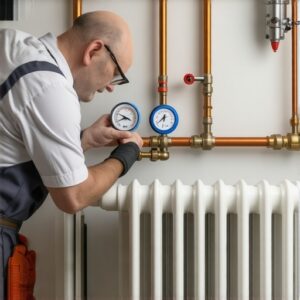
How do you catch a bad trap? Don’t touch it with your bare hands unless you want a trip to the ER. Use an infrared thermometer. The inlet should be hot (212°F+), and the outlet should be significantly cooler if it’s cycling. If the ‘juice’ (the heat) is the same on both sides, the trap is failed open. This is a common issue I find during furnace tune-up services in older apartment buildings. Replacing the ‘guts’ of the trap is usually the answer. You unscrew the cap, drop in a new cage unit, and suddenly the radiator stops hissing. It’s not magic; it’s maintenance. While you’re at it, check your thermostat installation. Many people put their sensors too close to these radiating monsters, causing the rest of the house to freeze while one room cooks. For more on how to manage these nuances, check out the heating service hacks for comfort and savings in 2025. We see a lot of people trying to use Pookie (mastic) to seal steam leaks—don’t be that guy. Steam will eat through duct mastic like a hot knife through butter. Use the right pipe dope or Teflon tape rated for high temps.
Why Airflow Still Matters in a Water World
Even in a hydronic setup, you might have an air handler for your AC. If that air handler repair isn’t done right, you’ll have suction lines that aren’t ‘beer can cold’ and an evaporator coil that’s a block of ice. I’ve seen sparkies (electricians) wire up a zoning system installation so poorly that the dampers fought the boiler’s pressure. You have to look at the house as a single thermal envelope. If you’re looking for a deep dive on these systems, read the ultimate guide to AC installation expert tips for 2025 success to see how the other half of your HVAC system should be behaving. Remember, whether it’s steam or R-454B refrigerant transition services, the goal is the same: moving heat from where you don’t want it to where you do. If your radiator is hissing, it’s losing the battle. Don’t let a ‘Sales Tech’ talk you into a $20,000 system when a $50 part and some expert furnace tune-up services can fix the problem. Comfort is physics, not a sales pitch. Stick to the basics, mind your traps, and keep the steam where it belongs.”,