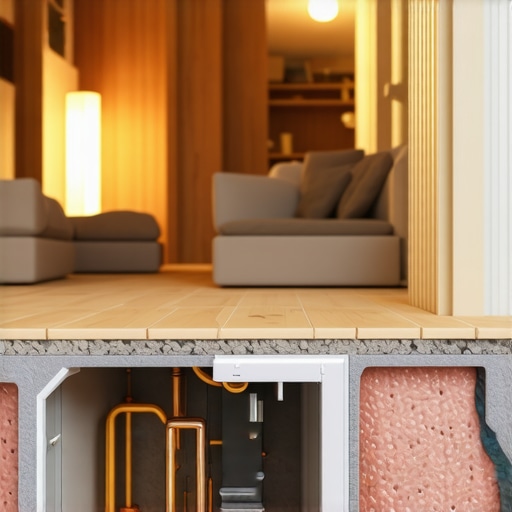
The Airflow Manifesto: Why Your Feet Are Freezing While Your Furnace Is Screaming
Listen, I’ve spent thirty years belly-crawling through damp dirt, dodging brown recluse spiders, and getting my coveralls snagged on rusty nails to tell you one thing: your furnace isn’t the problem. When you’re pacing your living room in January and your toes feel like they’re touching an ice rink, you don’t need a bigger heater. You need a physics lesson. My old mentor, a grizzled tin knocker who could bend 26-gauge steel with his bare hands, used to scream at me, ‘You can’t heat what you can’t touch!’ He was right. Most homeowners think of heating as a volume game—just pump more ‘hot stuff’ into the box. But comfort is actually a pressure and contact game. If the air isn’t moving across the right surfaces at the right velocity, you’re just burning money to heat the dust bunnies under your floorboards.
We are entering 2026, and the old ways of ‘just throw some fiberglass batts up there’ are dead. In fact, those pink rolls of insulation are often just ‘termite condos’ that trap moisture against your rim joists, leading to rot and a heating service nightmare. If you want a warm floor, you have to master the thermodynamic zooming of your crawl space. You have to understand the ‘Stack Effect’—how your house acts like a giant chimney, sucking cold air through the belly of your home and venting your expensive heat out through the attic. Here is the forensic breakdown of how we fix the frozen-toe syndrome once and for all.
“The most expensive equipment in the world cannot overcome a bad duct system.” – Industry Axiom
1. Smart Building Management & Thermostat Wiring Upgrades
In the old days, a thermostat was just a dumb bimetallic switch. Today, smart building management has reached the residential level. If your floor is cold, it’s often because your system doesn’t even know the crawl space exists. We’re now seeing thermostat wiring upgrades that involve multi-stage communication protocols. By installing remote sensors in the crawl space and floor joists, we can use relay services to trigger localized heat zones. Instead of the main furnace cycling on and off based on the temperature at eye-level in the hallway, the system monitors the temperature at the floor-level. This prevents the ‘stratification’ where the ceiling is 75°F but the floor is 58°F. If your sparky didn’t pull enough conductors for a modern communicating thermostat, you’re fighting a losing battle with 1970s logic in a 2026 world. You can find more about these technical shifts in our guide on heating service innovations transforming 2025 climate control.
2. Energy Recovery Ventilators (ERV) & The Humidity War
In Northern climates, we have a massive problem with ‘sensible heat’ vs. ‘latent heat.’ When you heat a crawl space, you change the relative humidity. If it gets too dry, your hardwood floors shrink and gap; if it’s too damp, you get mold. This is where energy recovery ventilators come into play. These units are the lungs of a modern new construction heating design. They swap the stale, damp air from your crawl space with fresh, filtered air from outside, but they use a heat exchanger to ‘rob’ the thermal energy from the outgoing air. It’s like magic—you get fresh air without losing the heat you paid for. Without an ERV, a sealed crawl space becomes a stagnant swamp. I’ve seen tin knockers try to just ‘dump a supply’ into the crawl space, but without a return path, you’re just pressurizing a tomb. You need a balanced airflow to keep those floors warm.
3. New Construction Heating Design: Beyond the Main House
If you’re building new or doing a major Reno, the new construction heating design must account for the garage and the crawl space as ‘conditioned’ or ‘semi-conditioned’ zones. I’ve been called out to countless jobs where the homeowner complained of a frozen kitchen floor, only to find the garage heater installation was done as an afterthought, leaving the shared wall and floor joists completely exposed to the elements. And don’t get me started on wood burning stove installation. People love the ‘aesthetic’ of a wood stove, but if it’s not vented properly with a dedicated combustion air intake, that stove will suck cold air right through your floorboards to feed the fire. It makes the room with the stove hot, but the rest of the house—and the floor—freezing cold. Proper flue pipe installation is critical here to ensure you aren’t creating a negative pressure zone that turns your floor into a vacuum for cold air.
“Ventilation shall be provided to provide a minimum of 0.35 air changes per hour but not less than 15 CFM per person.” – ASHRAE Standard 62.2
4. The Safety Layer: Carbon Monoxide & Flue Logic
When you start sealing up crawl spaces and adding garage heater installation or specialized wood stoves, you change the pressure mapping of the house. This is dangerous territory. Every single crawl space heating project I oversee requires a carbon monoxide detector installation. Why? Because if your flue pipe installation has a tiny leak, or if a ‘backdraft’ occurs because of your new high-powered exhaust fan, those deadly gases will pool in the low spots—like your crawl space. I’ve seen heating service calls turn into emergency evacuations because a cracked heat exchanger was dumping CO into the floor vents. You need to know how to identify when furnace repair is urgent and why, especially when dealing with the lower levels of your home where gas can linger. Don’t let a ‘sales tech’ tell you a cold floor just needs a bigger blower; make sure they check the integrity of your combustion system first.
The Verdict: Physics Beats Horsepower Every Time
At the end of the day, a warm floor is about static pressure and insulation continuity. If your ductwork is leaking, you’re blowing 120°F air into the dirt while your feet freeze. I always use ‘Pookie’ (mastic sealant) on every joint in the crawl space. Foil tape is for amateurs; it dries out and peels. Pookie is forever. When we seal those ducts and ensure the relay services are calling for heat based on the actual floor temperature, the ‘cold floor’ mystery vanishes. If you’re struggling with a system that feels like it’s underperforming, check out our choosing the right HVAC fixes guide. Stop listening to the guy trying to sell you a 5-ton unit for a 2-ton house. Fix the airflow, seal the ‘gas’ (refrigerant) leaks, and treat your crawl space like a part of your home, not a forgotten cave. Comfort isn’t magic; it’s just physics done right.