The Hard Truth About HVAC Warranties and Your Wallet
My old mentor, a grizzly guy who could smell a cracked heat exchanger from the driveway, used to scream at me, ‘You can’t heat what you can’t touch!’ He wasn’t talking about the metal; he was talking about the air. He knew that airflow is the lifeblood of the system, and the moment you choke it off, you start a timer on the equipment’s death. I watched him walk away from a warranty claim once because the homeowner hadn’t changed a filter in three years. The manufacturer denied a three-thousand-dollar heat exchanger replacement because of ‘neglect.’ That’s the reality the ‘Sales Techs’ won’t tell you while they’re trying to push a new unit: a warranty is only as good as your paper trail.
“The most expensive equipment in the world cannot overcome a bad duct system or a lack of verifiable maintenance.” – Industry Axiom
The Anatomy of a Warranty Denial
Manufacturers like Carrier, Trane, and Lennox aren’t in the business of giving away parts for free. When a blower motor replacement is needed, they want to know why it failed. If that motor is caked in dust because of poor furnace filter replacement habits, you’re footing the bill. In the cold climates of the North, where furnaces run 2,000 hours a season, the stress on these components is astronomical. We’re talking about sensible heat transfer that requires precise static pressure. When you neglect furnace flame sensor cleaning, the system cycles more often than it should, wearing out the igniter and the gas valve. This is called ‘short cycling,’ and it is the primary killer of high-efficiency furnaces.
Preventative care isn’t just about vacuuming out some dust. It’s about refrigerant leak detection for heat pump hybrids and ensuring the flue pipe installation hasn’t shifted due to house settling, which could lead to carbon monoxide backing up into the heat exchanger. These are the technical details that keep your family safe and your warranty intact. If you aren’t sure where to start, looking into preventative HVAC repair tips for year-round efficiency can save you a massive headache when the temperature drops below zero.
The Thermodynamic Reality of Maintenance
Let’s talk about the blower motor replacement. A modern ECM (Electronically Commutated Motor) is a piece of high-tech hardware. It’s designed to vary its speed to maintain airflow. But if your HEPA filter systems are clogged, that motor has to ramp up its torque to push air through a brick wall of dust. This increases the amp draw. High amps equal high heat. High heat kills the control board. If I show up for a capacitor replacement services call and find a burnt-out motor, the first thing I check is the maintenance log. No log? No warranty coverage.
We also have to look at the ‘unseen’ components. In multi-family heating upgrades, we often see occupancy sensor installation tied into the HVAC system. While great for energy savings, if not calibrated correctly, these sensors cause the furnace to kick on and off too frequently. This creates thermal stress on the heat exchanger. It’s the constant expansion and contraction of the metal that causes cracks. Proper biomass boiler services or standard gas furnace care requires a technician to measure the ‘temperature rise’—the difference between the air coming in and the air going out. If that’s out of spec, the metal is literally fatiguing itself to death.
“Maintenance shall be performed in accordance with the manufacturer’s instructions and shall include, at a minimum, the inspection of all safety controls and the cleaning of heat transfer surfaces.” – ASHRAE Standard 62.1
The Documentation Shield
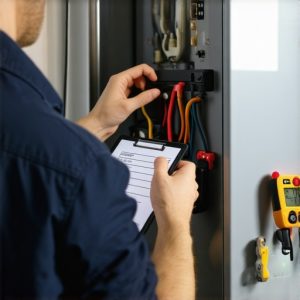
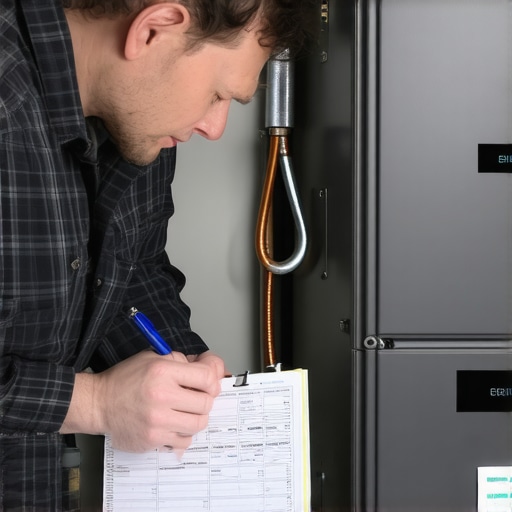
When you have a documented plan, you aren’t just paying for a technician to look at your furnace; you’re buying an insurance policy. A professional tech will perform furnace flame sensor cleaning using a specific abrasive pad—never sandpaper, which leaves silica on the probe—to ensure the ‘microamps’ are within the manufacturer’s range. This data is recorded. If the board fails later, we can prove the sensor was sending the right signal and the board was the lemon. This is how you win the warranty game. [image] If you’re dealing with a sudden breakdown, knowing how to identify when furnace repair is urgent is critical, but having that history of flue pipe installation checks and capacitor replacement services makes the repair process go from a ‘he-said-she-said’ battle to a simple parts swap.
For those in multi-family units or commercial spaces, multi-family heating upgrades often involve complex venting. If the flue pipe installation isn’t pitched at exactly a quarter-inch per foot, acidic condensate sits in the pipe and eats through the PVC or metal. A documented maintenance plan catches this before the furnace shuts down on a high-limit switch during a blizzard. It’s about the physics of combustion and the chemistry of exhaust. If you ignore the furnace filter replacement, you’re not just getting dirty air; you’re courting a catastrophic failure that no warranty will cover.
The 2025 Shift: Why Documentation Matters More Now
With the industry moving toward new refrigerants and higher efficiency standards, the cost of parts is skyrocketing. A control board that cost $200 five years ago is now $600. Manufacturers are becoming even stricter. They want to see that you’ve had refrigerant leak detection performed annually on your coils. They want to see that HEPA filter systems aren’t causing excessive static pressure that burns out the expensive blowers. You can find more about these shifts in our heating service innovations transforming 2025 climate control guide. Don’t let a ‘Sales Tech’ talk you into a whole new system when a well-maintained one could have lasted another decade. If you’re ready to get your system on a real plan, contact us today to start your paper trail. It’s better to have a $20 capacitor replaced during a routine visit than an $8,000 unit replaced because of a $20 part failure.