My old mentor used to scream, ‘You can’t cool what you can’t touch!’ This was his mantra for air conditioning, but when it came to heating, he’d modify it: ‘You can’t heat a home safely if you don’t respect the physics of fire.’ He was a grizzled old tin knocker who’d seen enough scorched drywall to last three lifetimes. He taught me that airflow matters more than horsepower, and that’s never truer than when you’re trying to shove a wood-burning stove into a small room. You aren’t just dealing with a cozy fire; you’re managing a thermodynamic engine that can either be your best friend during a polar vortex or a thermal runaway event waiting to happen. Most homeowners think they can just shove a stove in a corner and call it a day. They forget about radiant heat, pyrolytic decomposition, and the simple fact that a house needs to breathe.
The Forensic Diagnosis of Small Room Thermal Dynamics
When I walk into a ‘diagnosis’ where a customer complains about a wood stove making their small room feel like a kiln, I don’t look at the fire first. I look at the walls. In a small room, the radiant energy from a wood-burning stove is concentrated. This isn’t like your AC installation where the goal is moving air; this is about electromagnetic radiation hitting surfaces. If you don’t have the right clearances, those surfaces undergo a process called pyrolysis. Over years, the wood studs behind your drywall literally change their chemical composition, lowering their ignition temperature until—poof—the wall catches fire at a temperature that shouldn’t even melt a candle. That’s why IAQ improvement services and proper ventilation are non-negotiable.
“Clearance to combustibles is the most critical safety factor in any solid-fuel heating installation. Failure to maintain these distances often leads to structure fires that start inside the wall assembly.” – NFPA 211 Standard for Chimneys, Fireplaces, Vents, and Solid Fuel-Burning Appliances
In the North, where we deal with cracked heat exchangers and the constant threat of carbon monoxide, a wood stove or pellet stove repair isn’t just about making it work—it’s about ensuring it doesn’t kill you. If your room is tight, the stove will starve for oxygen, causing flame rollout and back-puffing. This is why we often recommend airflow measurement services even for non-ducted heat sources. You need to know if your house has enough ‘make-up air’ to support that fire without sucking carbon monoxide back down the furnace flue.
[image_placeholder_1]
The Clearances: Physics Over Aesthetics
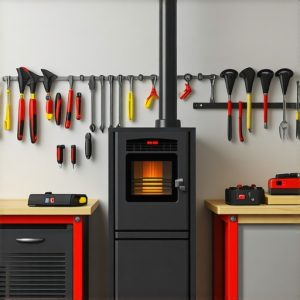
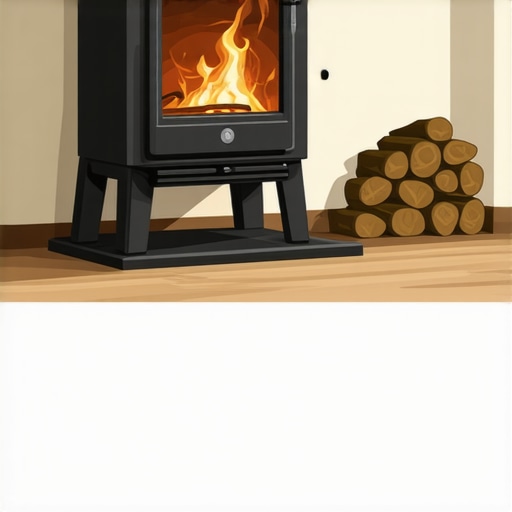
Standard clearances for an unlisted wood stove are typically 36 inches from any combustible surface. In a small room, 36 inches is a luxury you probably don’t have. This is where heat shields come in. By installing a non-combustible shield with a 1-inch air gap, you can often reduce those clearances by 50% to 66%. But don’t just use some scrap metal and some ‘Pookie’ (mastic) to hold it up. It needs to be engineered. The air gap allows convection to carry the heat away from the wall. If you screw a sheet of metal directly to the drywall, you’ve just created a heat conductor that will bake the wall even faster. It’s the same logic we use in a two-stage furnace installation: efficiency and safety are built into the design, not added as an afterthought.
While we’re talking about heat, let’s talk about the air quality. Wood stoves are notorious for drying out the air until your nose bleeds. This is why a bypass humidifier repair or installation on your main HVAC system is the perfect companion to a wood stove. You get the dry radiant heat from the wood, while the HVAC system manages the latent heat and moisture levels. If you’re feeling a ‘cold swamp’ vibe in the summer, you need dehumidification services, but in the winter, it’s all about adding that moisture back in. Balancing these systems is an art form. I’ve seen warranty service plans voided because a wood stove was so poorly installed that the soot fouled the secondary heat exchanger of the high-efficiency furnace nearby.
Integrating Modern HVAC with Traditional Fire
You might think a 30-year veteran would hate new-fangled tech, but I love a good two-stage furnace installation. Why? Because it can run its fan at a low, quiet speed to circulate the heat from your wood stove throughout the rest of the house. It turns your expensive wood heat into a whole-home solution. When I’m doing a consult, I often look at the contactor repair history on the AC side, too. If that contactor is pitted and burnt, it tells me the system is short-cycling. Often, it’s because the wood stove is tricking the thermostat, making the rest of the house a meat locker while the living room is a sauna. Proper thermostat placement and IAQ improvement services can fix this.
“The air distribution system shall be designed to provide a supply of air to every habitable room.” – ACCA Manual D
If you’re looking to upgrade your setup, don’t overlook rebate application assistance. Many local utilities in the cold zones offer massive incentives for switching to high-efficiency biomass or integrating them with heat pumps. It’s not just about the ‘juice’ (electricity) or the ‘gas’ (refrigerant/fuel); it’s about the total thermal envelope. We’ve helped folks get back thousands of dollars just by documenting their AC installation and furnace upgrades correctly. You can learn more about these transitions in our guide on heating service innovations transforming 2025 climate control.
Maintenance: The Difference Between Warmth and Worry
Whether it’s a pellet stove repair or a furnace repair, the enemy is always neglect. A wood stove needs its chimney swept, but it also needs its door gaskets checked. If that gasket is leaking, you’re losing control of the burn. It’s like a ‘Sparky’ (electrician) leaving a loose wire—it might work for a while, but eventually, heat builds up where it shouldn’t. For your main HVAC system, staying ahead of the curve is vital. Check out these top HVAC repair strategies to extend your system’s life. And for goodness sake, don’t believe the ‘Sales Tech’ who says you need a whole new system just because a capacitor blew. You can read about furnace repair myths debunked by industry experts to keep from getting fleeced.
Ultimately, safe clearances are about respecting the ‘Suction Line’ of life—the balance of what goes in and what comes out. If you’re installing a stove in a tight space, measure twice, shield once, and always ensure your IAQ improvement services are up to par. If you’re unsure, it’s time to call in a pro who knows the smell of an overheating wall versus a healthy fire. You can contact us for a real evaluation, not a sales pitch. Comfort is physics, not magic, and we’ve got the slide rules to prove it.