The Ghost in the Ductwork: Why Your High-Efficiency System is Failing
My old mentor used to scream, ‘You can’t cool what you can’t touch!’ This was his way of drilling into my thick skull that airflow matters more than horsepower. He’d be standing over a frozen evaporator coil or a scorched heat exchanger, pointing at a blower motor that was screaming for mercy, and he’d remind me that the most powerful furnace in the world is useless if it’s suffocating. This is the fundamental truth of HVAC that most modern ‘Sales Techs’—those guys who care more about their commission than your comfort—completely ignore. They see a dead blower and try to sell you a $15,000 system. I see a dead blower and I wonder why the static pressure was so high it literally cooked the motor’s windings. If you don’t address the underlying physics of the air, you’re just throwing expensive metal at a problem that won’t go away.
“The most expensive equipment in the world cannot overcome a bad duct system.” – Industry Axiom
Static pressure is the ‘blood pressure’ of your HVAC system. When it’s too high, the heart (the blower motor) has to work twice as hard to move the air. Eventually, it either burns out or, if it’s a modern ECM motor, it ramps up to its maximum RPM, making your house sound like a jet engine is taking off in the hallway. This is especially critical in commercial furnace repair where we deal with warehouse heating solutions. A warehouse has massive cubic footage, and if the ‘Tin Knocker’ who installed the original trunk lines didn’t account for friction loss, that shiny new Energy Star unit will never hit its rated efficiency. It’s like trying to run a marathon while breathing through a cocktail straw.
The Manometer Doesn’t Lie
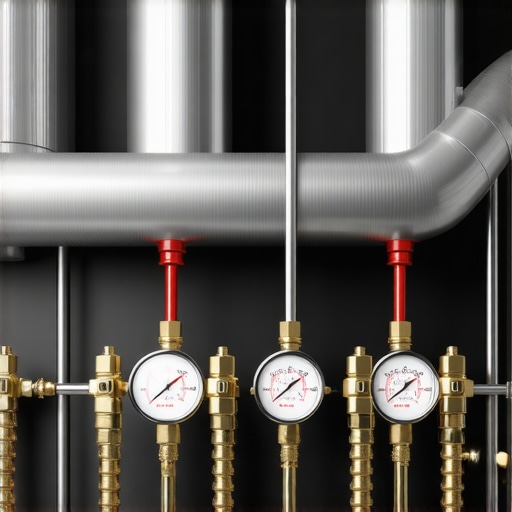
To find these silent killers, we use a digital manometer. We drill two small holes—one before the blower (the return side) and one after the heat exchanger (the supply side). The difference between these two readings is your Total External Static Pressure (TESP). Most residential systems are rated for a TESP of 0.5 inches of water column (wc). When I walk into a house and see 0.9 or 1.1 wc, I know the system is in a death spiral. High static pressure is why you have one room that’s an icebox and another that’s a sauna. It’s why how to identify when furnace repair is urgent often starts with listening for that high-pitched whistle in the vents.
“Design air flow shall be based on the heating and cooling loads as calculated by Manual J.” – ACCA Manual D
Silent Killers in Large Spaces: Churches and Warehouses
In church heating systems, the challenge is even greater. You have massive sanctuaries with vaulted ceilings and duct runs that might be 100 feet long. If the duct design services weren’t performed correctly, the air loses its velocity before it ever reaches the back pews. We often find that the furnace filter replacement schedule has been ignored, or worse, they’ve switched to those high-MERV 1-inch pleated filters that are basically like putting a piece of plywood in the duct. Those filters are great for air quality, but they are static pressure bombs. If you want high filtration, you need a 4-inch or 5-inch media cabinet that provides more surface area for the air to pass through without the resistance.
The Cold Climate Struggle: Furnaces and Insulation
Up here in the North, where the polar vortex turns every winter into a battle for survival, we see the ‘Silent Killer’ manifest in cracked heat exchangers. When a furnace can’t move enough air across the heat exchanger, the metal gets too hot. It expands and contracts too violently until it finally cracks, leaking carbon monoxide into the airstream. This is why preventative maintenance contracts are not just a luxury; they are a safety requirement. We also see issues when homeowners add attic insulation for heating. They’ll blow in three feet of cellulose and accidentally crush the flex duct or block the return grilles, sending the static pressure through the roof. It doesn’t matter if you have an Energy Star heating certification if your ducts are restricted by a mountain of insulation.
Modern Solutions: Geothermal and Advanced Control
For those looking at geothermal heat pump systems, airflow is even more sensitive. Geothermal units rely on specific flow rates to maintain the heat transfer cycle. If the static pressure is off, the whole thermodynamic process breaks down. Even if you’re using a wood burning stove installation for supplemental heat, you have to be careful about the pressure balance in the home. A powerful blower can actually create enough negative pressure to pull smoke back down the chimney if the house is too tight. Using top hvac repair strategies means looking at the house as a complete envelope, not just a collection of appliances.
Fixing the Problem: Pookie and Tin Knocking
The fix isn’t always a new unit. Sometimes, it’s as simple as using ‘Pookie’ (mastic) to seal up leaks in the plenum that are causing the system to lose its ‘juice’ before it gets to the rooms. Sometimes, it means a ‘Sparky’ needs to check the voltage to the blower because low voltage is causing it to lag. But most often, it’s about duct design services—adding a return air drop or enlarging a restrictive supply trunk. You can find some heating service hacks online, but nothing replaces a manometer test. If your tech doesn’t own a manometer, find a new tech. They’re just a parts-changer, not a technician. I’ve caught countless ‘Sales Techs’ trying to condemn a compressor when the actual problem was a collapsed return liner. They wanted to charge the customer $8,000 for a new outdoor unit when $300 of duct repair would have solved the ‘Suction Line’ pressure issue. Don’t be a victim of bad physics. Demand a static pressure test during every preventative hvac repair visit to ensure your system lives its full life.”,”image”:{“imagePrompt”:”A professional HVAC technician in a blue uniform using a digital dual-port manometer to measure static pressure on a silver commercial furnace in a mechanical room, detailed view of the probes inserted into the ductwork, high-quality technical photography.”,”imageTitle”:”Technician Measuring HVAC Static Pressure”,”imageAlt”:”HVAC technician performing a static pressure test on a commercial heating system using a digital manometer.”},”categoryId”:1,”postTime”:”2025-05-20T10:00:00Z”}