The Physics of Heat Transfer: Why Most People Fail Their Pellet Stoves
My old mentor used to scream, ‘You can’t heat what you can’t touch!’ at me every time I missed a spec of dust on an evaporator coil or a furnace heat exchanger. This wasn’t just old-school hazing; it was a fundamental lesson in thermodynamics. In the world of heating, whether you are dealing with a commercial furnace repair or a simple residential pellet stove, the metal is the medium. If there is a layer of fly ash between the fire and the heat exchanger, you are basically insulating your stove against its own heat. You might as well be burning money in the backyard.
When I walk into a house in the dead of a Northern winter and the owner is complaining that their stove ‘just doesn’t kick like it used to,’ I don’t look at the settings first. I look for the ash. Most homeowners think that dumping the ash pan is a ‘deep clean.’ It’s not. That’s like saying you cleaned your car because you emptied the ashtray. To keep a system running efficiently, especially when facing a 24/7 heating emergency response situation, you have to understand the forensic anatomy of the airflow path.
“The accumulation of even a 1/16th inch of soot or ash on a heat transfer surface can reduce efficiency by as much as 10 to 12 percent.” – ASHRAE Fundamentals Handbook
The Mechanical Anatomy: The Forensic Diagnosis of Your Stove
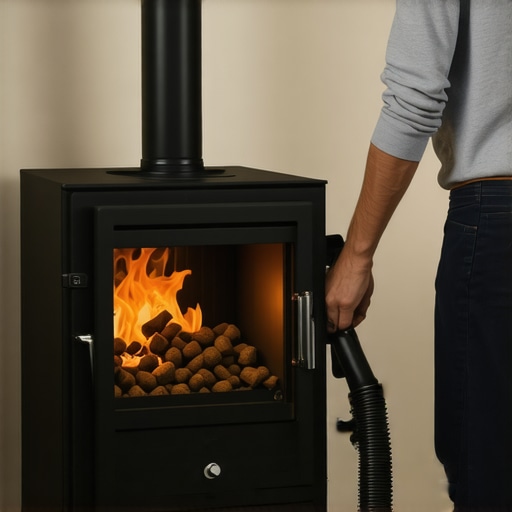
Let’s perform a forensic diagnosis on your pellet stove. You have three main components that require surgical precision with a vacuum: the burn pot, the heat exchange tubes, and the exhaust manifold. If you neglect these, you’re looking at an eventual blower motor replacement because the system has to work twice as hard to move the same amount of heat. I’ve seen tin knockers have to replace entire runs of venting because people let fly ash turn into a solid block of concrete inside the pipe.
First, the heat exchange tubes. These are usually located behind a decorative plate or accessible via a scraper rod. If you aren’t vacuuming the crevices between these tubes, you are losing sensible heat. Sensible heat is what you feel on your skin; it’s the energy that raises the temperature of the air. In cold climates like ours, we also have to worry about the lack of moisture. This is why many of my clients opt for whole-home humidifiers or a humidifier installation alongside their primary heating source. Dry air doesn’t hold heat well, and it makes 70 degrees feel like 65.
The Critical Areas You Are Missing: Beyond the Ash Pan
Most people forget the combustion blower housing. This is the ‘lungs’ of the stove. It pulls the air in and pushes the exhaust out. If fly ash builds up on the fan blades, the motor becomes unbalanced. You’ll hear that high-pitched screech—the sound of a bearing failing. That’s the same sound I hear right before a commercial furnace repair becomes a total system replacement. If you’re already in there with the vacuum, pull the side panels and get into the blower housing. Use a soft brush to dislodge the ‘Pookie’ (dust and ash mixture) from the blades.
Next is the exhaust manifold and the transition to the venting. This is where the ‘Gas’ (combustion byproduct) leaves the building. If this area is restricted, you get poor combustion. This leads to ‘lazy flames’ and excessive soot. If you’re worried about air quality, vacuuming isn’t enough. Many modern setups are incorporating UV light installation for HVAC systems and pellet stove intake paths to neutralize organic compounds, though in a pellet stove, it’s mostly about the particulate matter.
“All heating equipment shall be installed and maintained such that the flue gases are safely exhausted to the outside atmosphere.” – NFPA 211: Standard for Chimneys, Fireplaces, and Vents
The Math: Maintenance vs. The High Cost of Neglect
Let’s talk numbers. A high-quality HEPA ash vacuum costs about $100. A blower motor replacement will run you anywhere from $300 to $600 depending on the brand. If the heat exchanger cracks because of localized hot spots caused by uneven ash distribution, you’re looking at a $3,000 to $5,000 replacement. It’s the same logic I use when discussing preventative HVAC repair tips for year-round efficiency. A little bit of ‘elbow grease’ now prevents a massive ‘wallet hemorrhage’ later.
In a commercial setting, like hospital HVAC zoning, we don’t wait for things to break. We use occupancy sensor installation and thermostat installation with remote monitoring to track performance in real-time. You should treat your home stove with the same respect. If your thermostat is calling for heat but the room temperature isn’t rising, don’t just turn it up. Check the airflow. You might even need a pool heater repair technician if you’re lucky enough to have an indoor pool, but the physics remains the same: clean surfaces transfer heat; dirty ones don’t.
Air Quality and the Invisible Killers
In the North, where we seal our houses tight against the ‘Polar Vortex,’ indoor air quality is a major concern. When you are vacuuming your stove, you must use a vacuum specifically designed for ash. A standard shop vac has filters that are too porous. You’ll end up blowing microscopic fly ash throughout your living room. This ash can contain heavy metals and carbon. If you want to go the extra mile, consider an innovative heating service approach by adding whole-home humidifiers to keep the air at a healthy 40% humidity, which helps settle dust and makes the air easier to breathe.
If you’ve neglected your stove and now it’s acting up, don’t wait until the temperature drops below zero. You can identify when furnace repair is urgent by the smell of the air and the sound of the blowers. If you smell something ‘acidic’ or ‘sour,’ that’s likely a motor winding cooking itself. Shut it down and call a pro. For those who aren’t comfortable tearing into their stove’s guts, you can always contact us for a professional deep clean and safety inspection.
The Final Word on Comfort and Physics
At the end of the day, comfort isn’t magic; it’s physics. Whether you’re managing a hospital HVAC zoning project or just trying to stay warm in your den, the rules don’t change. You need fuel, you need oxygen, and you need a clean surface to transfer that energy. Stop being a ‘Sales Tech’ victim who thinks every problem requires a new unit. Most of the time, all you need is a vacuum and the knowledge of where to stick the nozzle. Keep the ash out of the ‘lungs’ of your system, and it’ll take care of you when the North wind starts to howl.